
Happer, Lindzen Comment to the Securities and Exchange Commission, Rescission of the Climate-Related Disclosure for Investors Rule
Richard Lindzen
Professor of Earth, Atmospheric, and Planetary Sciences, Emeritus, Massachusetts Institute of Technology
William Happer
Professor of Physics, Emeritus, Princeton University
Comment on the
SEC’s Rescission of Climate-Related Disclosure Rule File No. S7-2026-19 (Aug. 3, 2026)
THE UNTOLD SCIENCE OF GHGs DEMONSTRATES THE
CLIMATE-RELATED DISCLOSURE RULE MUST BE RESCINDED
August 3, 2026
A. Countryman, Secretary
Securities and Exchange Commission 100 F Street NE
Washington DC 20549-1090
Dear Secretary Countryman:
Thank you for the opportunity to comment on the proposed Rescission of the Climate-Related Disclosure for Investors Rule, 90 FR 33,296 (June 3, 2026)(“Rescission Rule”).
It will rescind the Climate-Related Disclosure for Investors Rule, 89 FR 21,668 (March 28, 2024)(“Final Rule”) that requires companies to report carbon dioxide (“CO2”) and other greenhouse gas (“GHG”) emissions based on the theory they cause “higher temperatures, sea level rise, and droughts” and “hurricanes, floods, tornadoes, and wildfires” (the “Human Caused Global Warming Theory”). Id. 21,692.
I. Summary
We are career physicists who have specialized in radiation physics and dynamic heat transfer for decades. Contrary to the Human Caused Global Warming Theory, the untold physics of CO2 is that CO2 has had virtually no warming power since 1750, when the CO2 level in the atmosphere was about 280 parts per million (“ppm”). Further, the physics is that the five other EPA listed GHGs are too small to matter.
Therefore, increasing CO2 since 1750 and into the future has caused and will only cause tiny increases in global temperatures and thus no extreme weather. However, increasing CO2 will create more food for people worldwide and reducing CO2 will reduce food worldwide.
As a result, the Final Rule will harm, not benefit, investors because it mandates companies to disclose scientifically false and misleading information that these GHGs cause high temperatures and extreme weather.
Further, the Final Rule’s costs are enormous. Rescinding the Final Rule “could generate annualized savings of about $4.9 billion per year over the next 10 years.” 90 FR p. 33,312.
Unless the rule is rescinded, these costs will be imposed on affected companies.
We acknowledge our conclusions are totally contrary to the consensus. However, science is determined by the scientific method, not by consensus.
Thus the Final Rule must be rescinded. Scientific details follow.
Table of Contents
I. Summary 1
II. The Untold Science that CO2 Has Had Virtually No Warming Power Since 1750 and the Other EPA GHGs Are Too Small to Matter
A. What is, and Is Not, Science
B. We Need Only Focus on CO2 Because the Other EPA Listed GHGs Are Too Small to Matter
C. The Physics of Why CO2 Has Had Virtually No Warming Power Since 1750
D. The Physics that CO2 Over 280 ppm Has Virtually No Warming Power Explains Why Temperatures Were Not Catastrophically High When CO2 Levels Were Much Higher Than Today for Hundreds of Millions of Years
Conclusion
Curriculum Vitae
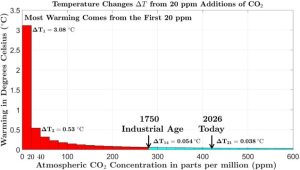
Fig. 1. CO2’s Warming Power Decreases Very Rapidly With More CO2
II. The Untold Science that CO2 Has Had Virtually No Warming Power Since 1750 and the Other EPA GHGs Are Too Small to Matter
A. What Is, and Is Not, Science
As scientists, we totally agree with the Supreme Court: “‘scientific knowledge’ … must be derived by the scientific method.” Daubert v. Merrell Pharmaceuticals, Inc., 509 U.S. 579, 593 (1993).
What is the scientific method? Prof. Richard Feynman, a Nobel Laureate in Physics, provided an incisive definition:
“[W]e compare the result of [a theory’s] computation to nature, … compare it directly with observations, to see if it works. If it disagrees with experiment, it is wrong. In that simple statement is the key to science.” The Character of Physical Law (1965) 150.
Agreement with observations is the measure of scientific truth. Scientific progress proceeds by the interplay of theory and observation. Theory explains observations and makes predictions of what will be observed in the future. Observations anchor understanding and weed out the theories that do not work. Therefore, “Scientific data are the coin of the realm in science, and they are always treated with reverence.”1 This has been the scientific method for more than four hundred years.
What is not science? Science is not determined by unscientific sources, such as consensus, government opinions, peer review, models that do not work, omitting contradictory science and cherry picked, fabricated or falsified data.2
B. We Need Only Focus on CO2 Because the Other EPA Listed GHGs Are Too Small to Matter
The major GHGs that influence the Earth’s atmosphere are water vapor, which accounts for more than 90% of the atmosphere’s ability to intercept heat, and clouds.3
For whatever reason, the EPA and many others focus on six minor GHGs: carbon dioxide, methane, nitrous oxide, hydrofluorocarbons, perfluorocarbons, and sulfur hexafluoride. EPA Endangerment Findings. 74 Fed. Reg. p. 66,516.
Of the six minor GHGs, we focus on carbon dioxide for two reasons.
First, as a matter of physics, the warming effect of the five other GHGs are too small to matter. “Radiative effects of CH4 [methane] and N2O [nitrous oxide] are so small that they are irrelevant to climate,” as are the other three.4
Second, the Intergovernmental Panel on Climate Change (“IPCC”) view is that “carbon dioxide remains the most important contributor to anthropogenic forcing of climate change.”5
C. The Physics of Why CO2 Has Had Virtually No Warming Power Since 1750
As shown in Fig. 1, the warming per added CO2 molecule decreases as the concentration in the atmosphere increases. It is undisputed in science that CO2’s warming power decreases logarithmically.
We computed Table1 below and used that data to prepare Fig. 1 to show how rapidly CO2’s warming power decreases.6
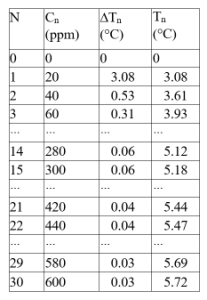
Table 1. The 1st column is the number, n, of concentration increments of 20 ppm added to the atmosphere.
The 2nd column shows the cumulative concentration level of CO2, Cn.
The 3rd column shows the incremental warming, ΔTn, caused by adding a 20 ppm increment of CO2 to the last CO2 level.
The 4th column shows the cumulative warming, Tn, after n increments of 20 ppm of CO2.
Starting with no CO2 in the atmosphere, Table 1 shows the first 20 parts per million (ppm) of CO2 raises the temperature on the order of 3.08°C.
However, the next 20 ppm of CO2 rapidly decreases to only increase the temperature 0.53°C, about one-fifth as much.
This is how quickly CO2 loses its warming power after only 40 ppm in the atmosphere. In 1750 at the beginning of the Industrial Age, the CO2 level was about 280 ppm.
Given the very rapid decrease in CO2’s warming power, CO2 by then had lost virtually all its warming power. Table 1 shows that another 20 ppm of CO2 at the 280 ppm level would onlyincrease global temperatures by about 0.06 °C.
How much warming did CO2 cause when CO2 increased from 280 ppm in 1750 to the 420 ppm in the atmosphere today?
Very little. Table 1 shows a temperature increase of only 0.32 °C (from 5.12 to 5.44 °C).
What about the future? What will happen if nothing is done to reduce CO2 emissions from fossil fuels and other human sources by 2100?
Again very little. Human emissions are increasing CO2 concentration so that in 75 years the CO2 level in the atmosphere will be about 600 ppm.7
Table 1 shows that the warming resulting from CO2 concentration increasing from 420 ppm to 600 ppm would only increase global temperatures 0.28 °C, increasing from 5.44 °C at 420 ppm to 5.72 °C at 600 ppm.
Accordingly, the physics of CO2 demonstrates that CO2 has had virtually no warming power since 1750 at 280 ppm and the physics of the five other EPA listed GHGs are too small to matter.
Thus, the Final Rule mandates companies to disclose scientifically false and misleading information that these GHGs cause high temperatures and extreme weather. Therefore the Final Rule must be rescinded.
D. The Physics that CO2 Over 280 ppm Has Virtually No Warming Power Explains Why Temperatures Were Not Catastrophically High When CO2 Levels Were Much Higher Than Today for Hundreds of Millions of Years
The chart below shows:
• CO2 levels on the left vertical axis
• global temperatures on the right vertical axis
• time over 600 million years on the horizontal axis at the bottom.8 The blue line shows CO2 levels.
The red line shows temperature.
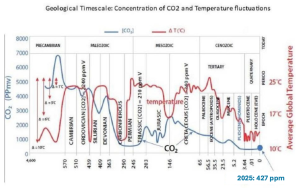
The Final Rule is based on the Human Caused Global Warming Theory, which predicts there would have been dangerously warm temperatures over the roughly 500 million years when CO2 was higher than today.
The chart contradicts the Theory with data. Although the data are based on various proxies, with the attendant uncertainties, they are good enough to demolish the Theory by observations. It also confirms our conclusions from physics that CO2 had virtually no warming power above 280 ppm. It shows, for example:
• For hundreds of millions of years, there was an inverse relationship between temperatures and CO2 levels. Temperatures were high when CO2 levels were low, and temperatures were low when CO2 levels were high. When CO2 was at a record high at about 7,000 ppm, temperatures were at a near-record low.
• Temperatures were at the highest they have ever been about 55 million years ago. CO2 levels were low.
• Temperatures were very high starting at 245 million years ago to about 8 million years ago. CO2 levels were very low all of this time except around 150 million years ago.
Why wasn’t there dangerous global warming for the hundreds of millions of years when CO2 levels were over 280 ppm?
Simple. As demonstrated, the physics of CO2 is that it has virtually no warming power above 280 ppm.
Accordingly, this confirms that the Final Rule would mandate companies to disclose scientifically false and misleading information that CO2 and these five other GHGs cause high temperatures and extreme weather. Therefore the Final Rule must be rescinded and upheld.
Conclusion
The Final Rule would require companies to disclose to investors CO2 and other GHG emissions data based on the Human Caused Global Warming Theory that they cause “higher temperatures, sea level rise, and droughts” and “hurricanes, floods, tornadoes, and wildfires,” at enormous expense.
Physics demonstrates they do not. Therefore the Final Rule would harm, not benefit, investors, by compelling companies to disclose scientifically false and misleading information about carbon dioxide and other GHGs.
Further, the Final Rule’s costs are enormous, on the order of $4.9 billion per year. 90 FR p. 33,312.
Thus the Final Rule must be rescinded and the SEC’s Rescission Rule must be upheld.
1 David Goodstein, How Science Works, in Federal Judicial Center, Reference Manual on Scientific Evidence (3rd Ed. 2011) 47.
2 For more detail, see our paper Physics Demonstrates That Increasing Greenhouse Gases Cannot Cause Dangerous Warming, Extreme Weather or Any Harm (June 7, 2025) 5-8.
3 Steven Koonin, Unsettled (2nd 2024) 51.
4 William van Wijngaarden and William Happer, “Methane and Climate” (2019), https://co2coalition.org/wp-content/uploads/2021/08/Methane-and-Climate.pdf 4; William van Wijngaarden & William Happer, Instantaneous Clear Sky Radiative Forcings of Halogenated Gases (June 23. 2023), https://arxiv.org/pdf/2306.13642
5 IPCC, Climate Change 1995: The Science of Climate Change xi.
6 William van Wijngaarden and William Happer, “Saturation Graphics” https://co2coalition.org/publications/saturation-graphics; our paper Physics Demonstrates That Increasing Greenhouse Gases Cannot Cause Dangerous Warming, Extreme Weather or Any Harm (June 7, 2025); our paper with Steven Koonin, Fossil Fuels and Greenhouse Gases Climate Science – CO2 Coalition (April 2024); William Happer, “Logarithmic Warming by the Greenhouse Gas CO2” (forthcoming).
7 Human emissions are increasing CO2 concentration by about 2.5 ppm per year. Thus in 75 years the CO2 level would be about 600 ppm (420 ppm + 75×2.5 = 420 + 188 = 608).
8 Nasif Nahle, Geologic Global Climate Changes, Biology Cabinet J. (Mar. 2007). Updated by Greg Wrightstone May 2026.
Curriculum Vitae
Richard Lindzen, Ph.D.
I am an Alfred P. Sloan Professor of Atmospheric Science Emeritus at MIT. After completing my doctorate at Harvard in 1964 (with a thesis on the interaction of photochemistry, radiation and dynamics in the stratosphere), I did postdoctoral work at the University of Washington and at the University of Oslo before joining the National Center for Atmospheric Research as a staff scientist. At the end of 1967, I moved to the University of Chicago as a tenured associate professor, and in 1971 I returned to Harvard to assume the Gordon McKay Professorship (and later the Burden Professorship) in Dynamic Meteorology. In 1981 I moved to MIT to assume the Alfred P. Sloan Professorship in Atmospheric Sciences. I have also held visiting professorships at UCLA, Tel Aviv University, and the National Physical Laboratory in Ahmedabad, India, and the Hebrew University in Jerusalem, the Jet Propulsion Laboratory in Pasadena, and the Laboratory for Dynamic Meteorology at the University of Paris.
I developed our current understanding of the quasi-biennial oscillation of the tropical stratosphere, the current explanation for dominance of the solar semidiurnal and diurnal tides at various levels of the atmosphere, the role of breaking gravity waves as a major source of friction in the atmosphere, and the role of this friction in reversing the meridional temperature gradient at the tropopause (where the equator is the coldest latitude) and the mesopause (where temperature is a minimum at the summer pole and a maximum at the winter pole). I have also developed the basic description of how surface temperature in the tropics controls the distribution of cumulus convection and led the group that discovered the iris effect where upper-level cirrus contract in response to warmer surface temperatures. I have published approximately 250 papers and books. I am an award recipient of the American Meteorological Society and the American Geophysical Union. I am a fellow of the American Meteorological Society, the American Geophysical Union and the American Association for the Advancement of Science, and a member of the National
Academy of Sciences and the American Academy of Arts and Sciences.
I have served as the director of the Center for Earth and Planetary Sciences at Harvard and on numerous panels of the National Research Council. I was also a lead author on the Third Assessment Report of the UN’s Intergovernmental Panel on Climate Change – the report for which the IPCC shared the Nobel Peace Prize with Al Gore.
William Happer, Ph.D.
I am a Professor Emeritus in the Department of Physics at Princeton University.
I began my professional career in the Physics Department of Columbia University in 1964, where I served as Director of the Columbia Radiation Laboratory from 1976 to 1979. I joined the Physics Department of Princeton University in 1980.
I invented the sodium guidestar that is used in astronomical adaptive optics systems to correct the degrading effects of atmospheric turbulence on imaging resolution. I have published over 200 peer-reviewed scientific papers, am a Fellow of the American Physical Society, the American Association for the Advancement of Science, and a member of the American Academy of Arts and Sciences, the National Academy of Sciences and the American Philosophical Society.
I served as Director of Energy Research in the U.S. Department of Energy from 1991 to 1993. I was a co-founder in 1994 of Magnetic Imaging Technologies Incorporated (MITI), a small company specializing in the use of laser-polarized noble gases for magnetic resonance imaging. I served as Chairman of the Steering Committee of JASON from 1987 to 1990.
I served as Deputy Assistant to the President and Senior Director for Emerging Technologies at The National Security Council in the White House from 2018 to 2019.
I am the Chair of the Board of Directors of the CO2 Coalition, a nonprofit 501(c)(3) organization established in 2015 to educate thought leaders, policy makers and the public about the vital contribution made by carbon dioxide to our lives and our economy.
Download the Lindzen, Happer Comment to the Securities and Exchange Commission, Rescission of the Climate-Related Disclosure for Investors Rule here:
Lindzen Happer SEC Disclosure Rule Comment 8-3-26 Final