
Lindzen/Happer Comment on Rescission of the Greenhouse Gas Findings for Fossil Fuel-Fired Power Plants
Richard Lindzen
Professor of Earth, Atmospheric, and Planetary Sciences, Emeritus, Massachusetts Institute of Technology
William Happer
Professor of Physics, Emeritus, Princeton University
October 30, 2026
U.S. Environmental Protection Agency
Docket Center ID No. EPA-HQ-OAR-2025-0124
1200 Pennsylvania Avenue NE
Washington, D.C. 20004
Re: Rescission of the Greenhouse Gas Findings for Fossil Fuel-Fired Power Plants and Repeal of Regulations for Power Plant Greenhouse Gas Emissions Under Clean Air Act Section 111 (“Proposed Rule”)[1]
Dear Administrator Zeldin:
We are career physicists with a special expertise in radiation physics, which describes how carbon dioxide (CO2) and other GHGs affect heat flow in Earth’s atmosphere. Each of us has published over 200 peer-reviewed papers on the science of climate or closely related subjects. We are both members of the National Academy of Sciences. Our curricula vitae are in the appendix.
Thank you for the opportunity to comment on the EPA’s “proposed rescissions and repeals of the 2015 NSPS [New Source Performance Standards], 2024 CPS [Carbon Pollution Standards], and any underlying listings, findings, and determinations with respect to GHG [Greenhouse Gases] emissions from fossil fuel fired-EGUs [Electric Generating Units],” and “not limiting comment to …identified areas.” Proposed Rule, pp. 59006, 59044.
All the regulations are based on the Human-Caused GHG Warming Theory that major increases in the six major greenhouse gases, including carbon dioxide and five others,[2] cause major increases in global warming, which in turn cause increased extreme weather, such as more heat waves, hurricanes, storms and rising sea levels. As James Hansen, one of the proponents of the theory, put it, “CO2 is … the principal control knob of global climate change.”[3]
Our comments demonstrate that the Human-Caused GHG Warming Theory is flawed science. The public almost never hears three well-established facts:
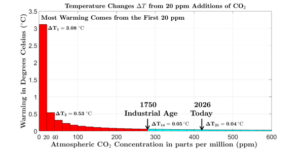
- Since 1750, CO2 has had little effect on global temperatures. All scientists agree that, as the atmospheric concentration of CO2 increases, each additional molecule very rapidly loses its warming power. 1 below shows warmings caused by 20 ppm (parts per million) additions of CO2 to the atmosphere. For a hypothetical atmosphere with no CO2, the first 20-ppm addition would cause a relatively large warming of 3.08 °C. For the 280 ppm concentrations of CO2 at the beginning of the industrial age, in the year 1750, a 20-ppm addition only provides a much smaller 0.054 °C of warming. At today’s concentration of 420 ppm, a 20-ppm addition warms by a trivial 0.038 °C.
- Annual warming from increasing methane, CH4, is about 10 times less than the small warming from CO2. Warming from nitrous oxide, N2O, is about the same as that from methane. Warming by the halogenated greenhouse gases is even smaller and does not matter.
- The most important greenhouse gas is not CO2 but water vapor (H2O). Water vapor is responsible for about two-thirds of the current greenhouse warming of the Earth. When the large radiative effects of clouds are included, water’s influence on Earth’s climate dwarfs that of CO2. Human activities have little effect on the water cycle of the Earth.
Fig. 1. CO2’s Warming Power Decreases Very Rapidly with More CO2
Moreover:
- Higher levels of CO2 have increased the food available for people worldwide and will continue to do so with higher levels of CO2. Doubling CO2 will increase the world’s food supply by about 40%, yet only slightly increase global temperatures. The very words “Carbon Pollution Standards” is Orwellian doublespeak. CO2 is a benefit to life on Earth, not a pollutant.
- The global effort to reduce CO2 emissions to Net Zero will be disastrous for people everywhere. First, it will reduce the amount of food that CO2 creates for people globally, increasing the threat of starvation. Second, it requires the elimination of the use of fossil fuels, which will deprive people worldwide of inexpensive energy. Yet, even if the Net Zero actions are 100% successful, they will have virtually no effect on global temperatures. Accordingly, all Net Zero actions worldwide should be stopped immediately.
- It is our opinion that the United States and the world are confronted with policies and government rules and actions that will destroy western economies, impoverish the working middle class, condemn billions of the world’s poorest to continued poverty and increased starvation, and leave our children despairing of their future.
Accordingly, the proposed rescission and repeal Rule when finalized should be upheld.
Finally, we understand the Supreme Court has made clear that “when an agency makes … scientific judgments, … a reviewing court must be at its “most deferential.”[4] Thus we respectfully suggest the EPA make the scientific judgment in this final rule that CO2 and the other greenhouse gases have had little effect on global temperatures since 1750, will have even less effect in the future, and have not increased the severity or frequency of extreme weather. What warming has occurred has been mostly a natural recovery from the cold of the Little Ice Age and has been beneficial.
Supplementary Information
I. Scientific Theories Are Determined by the Scientific Method, Validating Theoretical Predictions with Observations, Not by Consensus, Government Opinion, Peer Review, Models That Do Not Work, or Fabricated, Falsified or Omitted Contradictory Science
At the outset, it is fundamental to distinguish between what is, and is not, science.
As scientists, we totally agree with the U.S. Supreme Court: “‘scientific knowledge’ … must be derived by the scientific method.” Daubert v. Merrell Pharmaceuticals, Inc., 509 U.S. 579, 593 (1993).
What is the scientific method? Prof. Richard Feynman, a Nobel Laureate in Physics, provided a simple yet profound definition:
“[W]e compare the result of [a theory’s] computation to nature, … compare it directly with observations, to see if it works. If it disagrees with experiment, it is wrong. In that simple statement is the key to science.” The Character of Physical Law (1965) 150.
Agreement with observations is the measure of scientific truth. Scientific progress proceeds by the interplay of theory and observation. Theory explains observations and makes predictions of what will be observed in the future. Observations anchor understanding and weed out the theories that do not work. This has been the scientific method for more than four hundred years. Thus, “Scientific data are the coin of the realm in science, and they are always treated with reverence.”[5]
What is not science? Science is not determined by unscientific sources, such as consensus; government opinions; peer review; models that do not work; cherry-picked, fabricated and falsified data[6] and omitting contradictory science and data.
Finally, the law similarly holds agency action invalid “if the agency has relied on factors which Congress has not intended it to consider [such as from unscientific sources, or] entirely failed to consider an important aspect of the problem”[7], as detailed here.
II. The EPA Rules Being Repealed: 2015 New Source Performance Standards (NSPS) and 2024 Carbon Pollution Standards (CPS)
The EPA makes clear they are based on the Human-Caused Global Warming Theory.
The EPA’s 2015 NSPS (New Source Performance Standards[8] states:
“In this action, the EPA is issuing final standards of performance to limit emissions of GHG pollution manifested as CO2 from [various fossil fuel-fired EGUs]…. these standards reflect the degree of emission limitation achievable through the application of the best system of emission reduction (BSER)…”
The EPA’s 2024 Carbon Pollution Standards rule[9] states:
“These final actions reduce the emissions of GHGs from new and existing fossil fuel-fired EGUs [Electrical Generating Units]. The increasing concentrations of GHGs in the atmosphere are, and have been, warming the planet, resulting in serious and life-threatening environmental and human health impacts. The increased concentrations of GHGs in the atmosphere and the resulting warming have led to more frequent and more intense heat waves and extreme weather events, rising sea levels, and retreating snow and ice, all of which are occurring at a pace and scale that threaten human health and welfare.”
III. CO2’s Very Rapid Loss of Warming Power
Scientists with competence in radiative transfer recognize that CO2’s warming effect decreases very rapidly as its concentration increases. In technical terms, for CO2 concentrations above about 1 ppm (part per million), warming is proportional to the logarithm of the CO2 concentration, not proportional to the concentration. Fig. 1 shows how rapidly CO2 loses its warming power.
Table 1 shows the numbers used to prepare Fig. 1. Those with a technical background can find details in the paper Saturation of warming by the greenhouse gas CO2.[10] Starting with no CO2 in the atmosphere, Table 1 shows that the first 20 ppm of CO2, which increases the total concentration to C1 = 20 ppm, raises the temperature by DT1 = 3.08 °C. This first temperature increment includes the transition from linear warming for CO2 concentrations C less than 1 ppm, to much smaller warmings, proportional to the logarithm of the CO2 concentration for C greater than 1 ppm. As can be seen in Fig. 1, most of CO2’s warming comes from the first 20 ppm addition of this hypothetical scenario. The next 20 ppm addition of CO2, which increases concentration to a total of C2 = 40 ppm, only increases the temperature DT2 = 0.53 °C, about one-fifth as much as the first addition.
| n | Cn (ppm) |
∆Tn
(°C ) |
Tn
(°C ) |
| 0 | 0 | 0 | 0 |
| 1 | 20 | 3.08 | 3.08 |
| 2 | 40 | 0.53 | 3.61 |
| 3 | 60 | 0.31 | 3.93 |
| ··· | ··· | ||
| 14 | 280 | 0.06 | 5.12 |
| 15 | 300 | 0.05 | 5.18 |
| ··· | ··· | ||
| 21 | 420 | 0.04 | 5.44 |
| 22 | 440 | 0.04 | 5.47 |
| ··· | ··· | ||
| 29 | 580 | 0.03 | 5.69 |
| 30 | 600 | 0.03 | 5.72 |
Table 1. The first column is the number, n, of CO2 concentration increments of 20 ppm added to the atmosphere. The second column is the resulting CO2 concentration, Cn, in ppm. The third column is greenhouse warming DTn from the nth increment, and the last column is the total warming Tn from all added CO2.
For the CO2 concentrations, 280 ppm, at the beginning of the industrial revolution in the year 1750, every doubling of concentrations must cause the same warming, a temperature increment dT called the climate sensitivity. The feedback-free climate sensitivity is around dT = 1 °C. Most feedbacks in nature are negative, in accord with Le Chatelier’s principle:
Le Chatelier’s principle states that if a dynamic equilibrium is disturbed by changing the conditions, the position of equilibrium shifts to counteract the change to reestablish an equilibrium. If a chemical reaction is at equilibrium and experiences a change in pressure, temperature, or concentration of products or reactants, the equilibrium shifts in the opposite direction to offset the change.
In agreement with Le Chatelier’s principle, we have assumed that the climate sensitivity has been reduced by negative feedbacks to dT = 0.56 °C to make Table 1 and Fig. 1. Predictions of large warmings from CO2 require large positive feedbacks, which would violate Le Chatelier’s principle, and which also cannot be reconciled with the geological record below, that shows very little correlation between CO2 concentrations and temperatures.
As summarized by Table 1, the increase of atmospheric CO2 concentrations from fossil-fuel combustion and other human sources since the beginning of the Industrial Age in 1750, when C = 280 ppm to the year 2025, when C = 420 ppm, has caused a warming (5.44 – 5.12)°C = 0.32°C, about 1/4 of the observed total. As mentioned above, fully doubling the pre-industrial concentration for 280 ppm to 560 ppm would only add dT = 0.56 °C of temperature rise. There is no scientific reason to think that this small temperature rise will cause an increase of extreme weather or any other harm. But the doubling CO2 concentrations will be a major benefit to agriculture.
As we mentioned above, annual warming from increasing methane, CH4, is about 10 times less than the small warming from CO2. Warming from nitrous oxide, N2O, is about the same as that from methane. The warming from both methane and nitrous oxide is subject to similar laws of diminishing returns. Warming by the halogenated greenhouse gases is even smaller and does not matter.
IV. Geological record of little correlation between atmospheric CO2 concentrations and temperature for hundreds of millions of years
The chart below shows:
- Estimates of CO2 concentrations, the blue line with values marked on the left vertical axis, versus time along the horizontal axis, from about 600 million years ago to the present.
- Estimates of temperatures, the red line with values marked on the right vertical axis.
Geological Timescale: Concentration of CO2 and Temperature fluctuations
The Human-Caused Global Warming Theory predicts there would have been dangerously warm temperatures over the roughly 500 million years when CO2 was about ten times higher than today. The estimates in the chart contradict the theory that CO2 is the control knob of Earth’s climate. There is little correlation between CO2 concentrations and temperature.
For example:
- When CO2 was at a record high at about 7,000 ppm, temperatures were at a near-record low.
- Temperatures were at the highest they have ever been about 55 million years ago. CO2 levels were relatively low.
Although the data of the chart are based on various proxies, with the attendant uncertainties, they imply that factors other than greenhouse gases have always controlled Earth’s temperature and continue to do so today.
Conclusion:
- Higher levels of CO2 have increased the food available for people worldwide and will continue to do so with higher levels of CO2. Doubling CO2 will increase the world’s food supply by about 40%, yet only slightly increase global temperatures.
- The global effort to reduce CO2 emissions to Net Zero will be disastrous for people worldwide. First, it will reduce the amount of food CO2 creates for people globally and increase the threat of starvation. Second, it requires the elimination of the use of fossil fuels, which will deprive people worldwide of inexpensive energy. Yet even if the Net Zero actions are 100% successful, they will avert less than DT = 1 °C of warming. Accordingly, all Net Zero actions worldwide should be stopped immediately.
- It is our opinion that the United States and the world are confronted with policies and government rules and actions that will destroy Western economies, impoverish the working middle class, condemn billions of the world’s poorest to continued poverty and increased starvation, leave our children despairing of their future.
Accordingly, the Proposed Rule should be upheld.
Finally, we understand the Supreme Court has made clear that “when an agency makes … scientific judgments, … a reviewing court must be at its ‘most deferential.’”[11] Thus we respectfully suggest the EPA make the scientific judgment in its final rule that since 1750 CO2 and the five other Minor GHGs have had little effect on global temperatures and therefore have not caused more extreme weather or damages based on the science above.
Curriculum Vitae:
Richard Lindzen, Ph.D.
I am an Alfred P. Sloan Professor of Atmospheric Science Emeritus at MIT. After completing my doctorate at Harvard in 1964 (with a thesis on the interaction of photochemistry, radiation and dynamics in the stratosphere), I did postdoctoral work at the University of Washington and at the University of Oslo before joining the National Center for Atmospheric Research as a staff scientist. At the end of 1967, I moved to the University of Chicago as a tenured associate professor, and in 1971 I returned to Harvard to assume the Gordon McKay Professorship (and later the Burden Professorship) in Dynamic Meteorology. In 1981 I moved to MIT to assume the Alfred P. Sloan Professorship in Atmospheric Sciences. I have also held visiting professorships at UCLA, Tel Aviv University, and the National Physical Laboratory in Ahmedabad, India, and the Hebrew University in Jerusalem, the Jet Propulsion Laboratory in Pasadena, and the Laboratory for Dynamic Meteorology at the University of Paris.
I developed our current understanding of the quasi-biennial oscillation of the tropical stratosphere, the current explanation for dominance of the solar semidiurnal and diurnal tides at various levels of the atmosphere, the role of breaking gravity waves as a major source of friction in the atmosphere, and the role of this friction in reversing the meridional temperature gradient at the tropopause (where the equator is the coldest latitude) and the mesopause (where temperature is a minimum at the summer pole and a maximum at the winter pole). I have also developed the basic description of how surface temperature in the tropics controls the distribution of cumulus convection and led the group that discovered the iris effect where upper-level cirrus contract in response to warmer surface temperatures. I have published approximately 250 papers and books. I am an award recipient of the American Meteorological Society and the American Geophysical Union. I am a fellow of the American Meteorological Society, the American Geophysical Union and the American Association for the Advancement of Science, and a member of the National Academy of Sciences and the American Academy of Arts and Sciences.
I have served as the director of the Center for Earth and Planetary Sciences at Harvard and on numerous panels of the National Research Council. I was also a lead author on the Third Assessment Report of the UN’s Intergovernmental Panel on Climate Change – the report for which the IPCC shared the Nobel Peace Prize with Al Gore.
William Happer, Ph.D.
I am a Professor Emeritus in the Department of Physics at Princeton University.
I began my professional career in the Physics Department of Columbia University in 1964, where I served as Director of the Columbia Radiation Laboratory from 1976 to 1979. I joined the Physics Department of Princeton University in 1980.
I invented the sodium guidestar that is used in astronomical adaptive optics systems to correct the degrading effects of atmospheric turbulence on imaging resolution. I have published over 200 peer-reviewed scientific papers, am a Fellow of the American Physical Society, the American Association for the Advancement of Science, and a member of the American Academy of Arts and Sciences, the National Academy of Sciences and the American Philosophical Society.
I served as Director of Energy Research in the U.S. Department of Energy from 1991 to 1993. I was a co-founder in 1994 of Magnetic Imaging Technologies Incorporated (MITI), a small company specializing in the use of laser-polarized noble gases for magnetic resonance imaging. I served as Chairman of the Steering Committee of JASON from 1987 to 1990.
I served as Deputy Assistant to the President and Senior Director for Emerging Technologies at The National Security Council in the White House from 2018 to 2019.
I am the Chair of the Board of Directors of the CO2 Coalition, a nonprofit 501(c)(3) organization established in 2015 to educate thought leaders, policy makers and the public about the vital contribution made by carbon dioxide to our lives and our economy.
[1] 91 FR 59,002 (Sept. 17, 2026)
[2] “methane, nitrous oxide (N2 O), hydrofluorocarbons (HFCs), perfluorocarbons (PFCs), and sulfur hexafluoride (SF6).” Proposed Rule, 91 FR p. 59,005. The EPA, unscientifically, ignores the Major GHGs that account for more than 90% of the greenhouse effect: water vapor and clouds. Steven Koonin, Unsettled 51 (2024 2d. ed.).
[3] James Hansen et. al, “The Role of Long-Lived Greenhouse Gases as Principal LW Control Knob that Governs the Global Surface Temperature for Past and Future Climate Change,” Tellus (Nov. 2013) 23.
[4] Seven County Infrastructure Coalition v. Eagle County, 145 S. Ct. 1497, 1512 (2025), citing Baltimore Gas & Electric Co. v. NRDC, 462 U.S. 87, 103 (1983)(“When examining this kind of scientific determination, as opposed to simple findings of fact, a reviewing court must generally be its most deferential.”) “The bedrock principle of judicial review … can be stated in a word: Deference.” Seven County, p. 1515.
[5] David Goodstein, How Science Works, in Federal Judicial Center, Reference Manual on Scientific Evidence (3rd Ed. 2011) 47.
[6] “Fabrication is making up data or results,” and “falsification is … changing or omitting data or results.” David Goodstein, On Fact and Fraud (2010) 135. For more detail, see our paper Lindzen-Happer-GHGs-and-Fossil-Fuels-Climate-Physics-2025-06-07.pdf 5-8, incorporated by reference here.
[7] Motor Vehicle Mfrs. Assn. U.S., Inc. v. State Farm Mutual Auto. Ins. Co., 463 U.S. 29, 43 (1983).
[8] Carbon Pollution Emission Guidelines for Existing Stationary Sources: Electric Utility Generating Units, 80 FR 64,510 (Oct. 23, 2015) p. 64,512.
[9] New Source Performance Standards for Greenhouse Gas Emissions From New, Modified, and Reconstructed Fossil Fuel-Fired Electric Generating Units; Emission Guidelines for Greenhouse Gas Emissions From Existing Fossil Fuel-Fired Electric Generating Units; and Repeal of the Affordable Clean Energy Rule, 89 FR 39,798 (May 9, 2024) , p. 39,800.
[10] W. Happer and L. Klett, Saturation of warming by the greenhouse gas CO2 https://co2coalition.org/publications/saturation-of-warming-by-the-greenhouse-gas-co2/.
W.A. van Wijngaarden, Saturation graphics,
https://co2coalition.org/publications/saturation-graphics/.
[11] Seven County Infrastructure Coalition v. Eagle County, 145 S. Ct. 1497, 1512 (2025), citing Baltimore Gas & Electric Co. v. NRDC, 462 U.S. 87, 103 (1983)(“When examining this kind of scientific determination, as opposed to simple findings of fact, a reviewing court must generally be its most deferential.”) “The bedrock principle of judicial review … can be stated in a word: Deference.” Seven County, p. 1515.
Download the comment here: