
Open Letter to Federal Judicial Center Chair, Chief Justice John Roberts
Richard Lindzen, Ph. D.
Professor of Earth, Atmospheric, and Planetary Sciences,
Emeritus Professor of Physics
Massachusetts Institute of Technology
William Happer, Ph. D.
Emeritus Professor of Physics, Princeton University
Steven Koonin, Ph. D.
Edward Teller Senior Fellow
Hoover Institution, Stanford University
April 1, 2026
The Honorable John G. Roberts
Chair, Federal Judicial Center
Chief Justice, United States Supreme Court
One First Street, NE
Washington, DC 20503
cc: Federal Judicial Center Board and Director
Re: “How Science Works” Chapter in the Reference Manual on Scientific Evidence: 4th Edition
Dear Chief Justice Roberts:
The Reference Manual on Scientific Evidence has long been valued by the federal and state judiciary for its neutrality, clarity, and restraint. It is used by more than 3,000 federal judges, many state judges, and has been cited in over 1,700 judicial opinions. Its purpose has always been to assist courts in evaluating scientific evidence—not to advance particular scientific, political, or policy agendas.
We write to express serious concerns about the Fourth Edition of the Manual, released a few months ago. Several chapters depart sharply from the Manual’s longstanding tradition of neutrality.
1. The Removed Climate Science Chapter Revealed Structural Problems
The most striking example was the “Reference Guide on Climate Science,” which was withdrawn after a letter from 28 state Attorneys General documented profound conflicts of interest and numerous unsupported claims presented as settled fact.
As career physicists with decades of experience in atmospheric dynamics, radiative transfer, and modeling complex systems like climate—and with more than 600 peer-reviewed publications among us—we were particularly concerned by that chapter’s scientific and procedural deficiencies. (Our curricula vitae are attached.)
2. The Remaining Chapter, “How Science Works,” Suffers from Similar Defects
Although the climate chapter has been removed, the chapter that undergirded it—”How Science Works”—remains. This chapter, 65 pages long, replaces the much shorter and widely respected 18-page version written for earlier editions by David Goodstein, former Vice Provost of Caltech. The new chapter does not acknowledge the prior version, nor does it resemble it in substance or tone.
The lead author of the new chapter, Professor Michael Weisberg, is a philosopher who also serves as a climate diplomat and advisor to several national delegations at the Conference of the Parties of the UN Framework Convention on Climate Change (COP) negotiations. His public biography highlights his work developing strategies to secure climate-related financial transfers for small island states. These roles do not inherently disqualify him. But they do create a clear appearance of conflict when writing a chapter intended to guide judges on what constitutes legitimate scientific evidence—particularly in litigation where trillions of dollars may be at stake.
3. The New Chapter Adopts an Advocacy Framework, Not a Scientific One
The very first paragraph asserts that “public relations campaigns have misled the public about the true state of scientific consensus,” citing Naomi Oreskes and Erik Conway’s Merchants of Doubt. That book—and the film based on it—explicitly argues that there is “zero argument among actual scientists” about catastrophic climate change.
This framing is inappropriate for a judicial reference text. It presents contested claims as settled fact, and it implies that dissenting scientists—including thousands of credentialed researchers—are not “actual scientists.” That is not a neutral description of scientific practice; it is an advocacy position.
4. The Gold Standard of Science Is Prediction Tested Against Reality
As scientists, we completely agree with the Supreme Court in the Daubert case that scientific knowledge must be derived by the scientific method:
“[I]n order to qualify as ‘scientific knowledge,’ an inference or assertion must be derived by the scientific method. *** ‘Scientific methodology today is based on generating hypotheses and testing them …this methodology is what distinguishes science from other fields of human inquiry.’” Daubert v. Merrell Dow Pharmaceuticals, Inc., 509 U.S. 579, 590, 593 (1993)(citations omitted).
Prof. Richard Feynman, a Nobel Laureate in Physics, succinctly explained the scientific method as follows:
“[W]e compare the result of [a theory’s] computation to nature, … compare it directly with observations, to see if it works. If it disagrees with experiment, it is wrong. In that simple statement is the key to science.” The Character of Physical Law (1965), p. 150.
For centuries, scientific progress has been grounded in the ability to make risky predictions—predictions that could easily be proven wrong—and then to test them against experiment or observation. This empirical cycle is the gold standard of scientific understanding. It is what enabled humanity to uncover the laws of motion, electromagnetism, thermodynamics, quantum mechanics, genetics, and countless other pillars of modern knowledge.
Historically, the scientific method was a new method of thinking that unleashed the Scientific Revolution. It differs from other common methods of thinking by testing theory with observations, with the facts controlling:
The scientific method “is a vehement and passionate interest in the relation of general principles to irreducible and stubborn facts. All the world over and at all times there have been practical men, absorbed in ‘irreducible and stubborn facts;’ all the world over and at all times there have been men of philosophic temperament who have been absorbed in the weaving of general principles. It is this union of passionate interest in the detailed facts with equal devotion to abstract generalization which forms the novelty in our present society.” Alfred North Whitehead, Science and the Modern World (1925) 3.
The new chapter ignores the scientific method explained by the Supreme Court above and erroneously asserts it is a “Myth” there is a single scientific method and states instead that it is an incomprehensible process:
“Myth: There is a single scientific method that all scientists follow.
“Fact: The process of science is nonlinear and dynamic.” Id. 102.
As detailed above, the new “How Science Works” chapter’s assertion that it is a “myth” there is a single scientific method is fundamentally incorrect science. The scientific method has been the foundation of modern science since the Scientific Revolution.
In contrast to the new chapter, Prof. David Goodstein’s “How Science Works” chapter in earlier editions of the Reference Manual explained that scientific knowledge is derived by the scientific method:
“In short, the essence of science is the scientific method.” 3rd Edition Reference Manual 39.
He explained the scientific method essentially the same way the Supreme Court and Prof. Feynman did:
“What’s required of a theory in science is that it make new predictions that can be tested by new experiments or observations and falsified or verified.” Id. 51.
He emphasized that “data are the coin of the realm in science, and they are always treated with reverence.” Id. 47.
Quoting Galileo, he observed, “In matters of science, the authority of thousands is not worth the humble reasoning of one single person.” Id. 47. That is, consensus is not the test in science.
He also observed that the scientific method and legal method are basically the same, which should be helpful and reassuring to judges and lawyers who are not trained in science:
“[S]cience and the law share, at the deepest possible level, the same aspirations and many of the same methods … using empirical evidence, to arrive at rational conclusions.” Id. 52.
5. Consensus Is Not the Foundation of Science
The new chapter repeatedly emphasizes “scientific consensus” and “widespread acceptance” as a defining feature of scientific validity. In a section titled “Achieving Scientific Consensus,” it presents “Figure 3. Indicators of scientific consensus, a spectrum from “low” to “high” of the “likelihood that consensus on a hypothesis has been reached.” Id. 97.
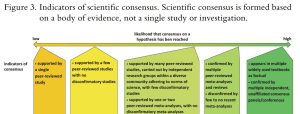
It then asserts that “the highest level of certainty science has to offer” is when a theory has “achieved widespread acceptance.” Id. 97. It also asserts, “widespread acceptance provides a strong indicator of the reliability of scientifically acquired knowledge.” Id. 96.
But consensus is a sociological phenomenon, not the scientific method. As Michael Crichton observed in a well-known lecture1.
“There is no such thing as consensus science. If it’s consensus, it isn’t science. If it’s science, it isn’t consensus.”
Consensus is an inferior and inherently fragile substitute for the gold-standard of science: testable predictions confronted with data. It is invoked primarily in fields where controlled experiments are difficult or impossible and where predictions cannot be decisively tested. It is vulnerable to groupthink, funding lock-in, and the natural human reluctance to acknowledge error.
Scientific progress—from Galileo to Curie to Einstein—has often required breaking with consensus, and history offers many examples in which a prevailing consensus was later overturned, including Lysenkoism in the Soviet Union, the long resistance to plate tectonics, and the brief mid-20th-century consensus about imminent global cooling. Even though consensus can be overturned by a single experiment or observation, it can persist long after contrary evidence has accumulated precisely because it is maintained socially rather than empirically.
This social maintenance of consensus also makes it important to not dismiss a priori the opinions of credentialed experts from other fields, as they need not be constrained by consensus thinking or rewards.
The new chapter cites the Antarctic ozone hole as an illustration of consensus functioning properly. Yet even here, the scientific picture is more complex than the chapter suggests. The springtime ozone hole over Antarctica has appeared every year since its discovery in 1979, when global satellite mapping began. Despite substantial declines in stratospheric halogen concentrations following the Montreal Protocol, the size and depth of the ozone hole have shown little systematic change. There remain scientifically credible reasons to question whether human-emitted halogens are the dominant cause of the phenomenon. As an example of “consensus science,” the ozone hole is far from straightforward.
If the chapter sought a clear illustration of how science should inform public policy, the causal link between cigarette smoking and lung cancer would have been far more appropriate. That relationship rests on converging lines of evidence, strong statistical associations, mechanistic understanding, and predictions repeatedly confirmed by observation. It exemplifies the empirical rigor that should guide judicial evaluation of scientific claims.
In summary, the new “How Science Works” chapter statement that “widespread acceptance” and “scientific consensus” is “the highest level of certainty science has to offer” and “provides a strong indicator of the reliability of scientifically acquired knowledge” is an egregious misstatement of what science has been since the Scientific Revolution in the 1600s – a discipline based on the scientific method.
Simply stated, if it’s consensus, it is not science.
1Michael Crichton, Aliens Cause Global Warming, Caltech Michelin Lecture, Jan. 17, 2003.
6. The Chapter Mischaracterizes Science as a Community-Governed Enterprise
Section headings such as “Science is Carried Out by a Community that Holds Members to Norms” and “Science as a Human and Community Endeavor” describe something closer to a political party or a religious order than to the scientific method. Science is indeed a human activity, but its authority derives from reproducible results, not from community norms or majority agreement.
The earlier Goodstein chapter captured this distinction clearly and succinctly. The new version obscures it.
7. Recommendations
We applaud the Federal Judicial Center’s removal of the “Reference Guide on Climate Science” chapter from the new Reference Manual because it is not the neutral and dispassionate statement of science the Manual is famous for2.
Because the “How Science Works” chapter was written in large part to support the now-withdrawn climate chapter—and because it departs so dramatically from the Manual’s tradition of neutrality—we respectfully recommend that it also be withdrawn before federal and state judges are mistakenly led to use it to admit or exclude scientific evidence, and its false science contaminates what we understand is more than 1,000 climate-related cases in state and federal courts.
We also respectfully recommend that it be replaced by the earlier Goodstein version that remains a concise, accurate, and non-ideological explanation of scientific reasoning appropriate for judicial use.
Further, Center Director Judge Rosenberg advised John McCuskey, the Attorney General of West Virginia, in a February 24th letter that the National Academy of Sciences (NAS) will not remove the “Reference Guide on Climate Science” chapter from its version of the Reference Manual: “The Academies will include asterisked language in its web and printed versions of the RMSE indicating that the FJC has omitted the chapter from its version of the manual.” We respectfully recommend the Center direct NAS to remove both the “How Science Works” and the “Reference Guide on Climate Science” chapters from their version of the Federal Judicial Center’s Reference Manual on Scientific Evidence: 4th Edition.
2 Its fundamental scientific flaws are detailed in Profs. Lindzen’s and Happer’s paper Physics Demonstrates That Increasing Greenhouse Gases Cannot Cause Dangerous Warming, Extreme Weather or Any Harm and in Prof. Koonin’s book Unsettled (2d. ed. 2024).
Respectfully submitted,

Richard Lindzen
I am an Alfred P. Sloan Professor of Atmospheric Science Emeritus at MIT. After completing my doctorate at Harvard in 1964 (with a thesis on the interaction of photochemistry, radiation and dynamics in the stratosphere), I did postdoctoral work at the University of Washington and at the University of Oslo before joining the National Center for Atmospheric Research as a staff scientist. At the end of 1967, I moved to the University of Chicago as a tenured associate professor, and in 1971 I returned to Harvard to assume the Gordon McKay Professorship (and later the Burden Professorship) in Dynamic Meteorology. In 1981 I moved to MIT to assume the Alfred P. Sloan Professorship in Atmospheric Sciences. I have also held visiting professorships at UCLA, Tel Aviv University, and the National Physical Laboratory in Ahmedabad, India, and the Hebrew University in Jerusalem, the Jet Propulsion Laboratory in Pasadena, and the Laboratory for Dynamic Meteorology at the University of Paris.
I developed our current understanding of the quasi-biennial oscillation of the tropical stratosphere, the current explanation for dominance of the solar semidiurnal and diurnal tides at various levels of the atmosphere, the role of breaking gravity waves as a major source of friction in the atmosphere, and the role of this friction in reversing the meridional temperature gradient at the tropopause (where the equator is the coldest latitude) and the mesopause (where temperature is a minimum at the summer pole and a maximum at the winter pole). I have also developed the basic description of how surface temperature in the tropics controls the distribution of cumulus convection and led the group that discovered the iris effect where upper-level cirrus contract in response to warmer surface temperatures. I have published approximately 250 papers and books. I am an award recipient of the American Meteorological Society and the American Geophysical Union. I am a fellow of the American Meteorological Society, the American Geophysical Union and the American Association for the Advancement of Science, and a member of the National Academy of Sciences and the American Academy of Arts and Sciences.
I have served as the director of the Center for Earth and Planetary Sciences at Harvard and on numerous panels of the National Research Council. I was also a lead author on the Third Assessment Report of the UN’s Intergovernmental Panel on Climate Change – the report for which the IPCC shared the Nobel Peace Prize with Al Gore.
William Happer
I am a Professor Emeritus in the Department of Physics at Princeton University.
I began my professional career in the Physics Department of Columbia University in 1964, where I served as Director of the Columbia Radiation Laboratory from 1976 to 1979. I joined the Physics Department of Princeton University in 1980.
I invented the sodium guidestar that is used in astronomical adaptive optics systems to correct the degrading effects of atmospheric turbulence on imaging resolution. I have published over 200 peer-reviewed scientific papers, am a Fellow of the American Physical Society, the American Association for the Advancement of Science, and a member of the American Academy of Arts and Sciences, the National Academy of Sciences and the American Philosophical Society.
I served as Director of Energy Research in the U.S. Department of Energy from 1991 to 1993. I was a co-founder in 1994 of Magnetic Imaging Technologies Incorporated (MITI), a small company specializing in the use of laser-polarized noble gases for magnetic resonance imaging. I served as Chairman of the Steering Committee of JASON from 1987 to 1990.
I served as Deputy Assistant to the President and Senior Director for Emerging Technologies at The National Security Council in the White House from 2018 to 2019. I am the Chair of the Board of Directors of the CO2 Coalition, a nonprofit 501(c)(3) organization established in 2015 to educate thought leaders, policy makers and the public about the vital contribution made by carbon dioxide to our lives and our economy.
Steven E. Koonin
I am the Edward Teller Senior Fellow at Stanford University’s Hoover Institution, which I joined in September 2024.
Prior to that, I was a University Professor at New York University, where I held appointments as a Professor of Information, Operations, and Management Sciences in the Stern School of Business and a Professor of Civil and Urban Engineering in the Tandon School of Engineering while serving as the Founding Director of the Center for Urban Science and Progress (CUSP).
I served as Undersecretary for Science at the U.S. Department of Energy from May 2009, following my confirmation by the U.S. Senate, until November 2011.
Prior to joining the government, I spent five years, from March 2004 to May 2009, as Chief Scientist for BP, p.l.c.
From September 1975 to July 2006, I was a professor of theoretical physics at Caltech and was the Institute’s Provost from February 1995 to January 2004.
I was a director of CERES, Inc., a publicly traded company pursuing genetically enhanced bioenergy crops, from 2012 to 2015 and have been an Independent Director of GP Strategies (now GP Government Solutions) since 2016.
My memberships include the U.S. National Academy of Sciences, the American Academy of Arts and Sciences, the Council on Foreign Relations. I am a former member of the Trilateral Commission. I am a member of the JASON advisory group from July 1988 to May 2009, and from November 2011 to present, and served as the group’s chair from 1998 to 2004.
I have served as an independent governor of the Los Alamos, of Lawrence Livermore National Security LLC since July 2012, and of the Sandia Corporation from 2016 to 2017 and was a member of the Secretary of Energy’s Advisory Board from 2013 to 2016. I have also served as a Trustee of the Institute for Defense Analyses from 2014 to 2025.
I hold a B.S. in Physics from Caltech (1972) and a Ph.D. in Theoretical Physics from MIT (1975).
cc: Judge Kathleen Cardone, U.S. District Court for the Western District of Texas
Judge Sara L. Ellis, U.S. District Court for the Northern District of Illinois
Judge Ralph R. Erickson, U.S. Court of Appeals for the Eighth Circuit
Judge Michelle M. Harner, U.S. Bankruptcy Court for the District of Maryland
Judge Suzanne Mitchell, U.S. District Court for the Western District of Oklahoma
Judge Kevin C. Newsom, U.S. Court of Appeals for the Eleventh Circuit
Judge B. Lynn Winmill, U.S. District Court for the District of Idaho
Judge Robert J. Conrad, Jr., Director of the Administrative Office of the U.S. Courts
Judge Robin L. Rosenberg, Director of the Federal Judicial Center
Note: A physical copy of this letter from Drs. Lindzen, Happer, and Koonin was mailed to Justice John Roberts and each Judge cc’d on April 1, 2026.
Download a copy of the letter here: