
Blizzard of Contradictions
by Brian C. Joondeph
Open the Denver Post and you might experience intellectual whiplash.
In one article, readers are warned that Colorado ski resorts face an uncertain future due to climate change, with “less reliable powder days” threatening the industry. Resorts must invest in snowmaking, diversify revenue streams, and brace for a warming planet.
Right beside it? A forecast of more than two feet of snow for Colorado’s mountain peaks.
Two feet.
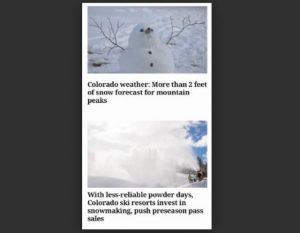
Screenshot The Denver Post February 16, 2026 // fair use
Apparently, the climate crisis is now capable of producing both the imminent demise of snow and an old-fashioned Rocky Mountain blizzard. Sometimes on the same page.
This is not satire. It’s modern climate journalism.
Climate journalism is actually a thing. The Washington Post employed 24-30 such journalists and recently laid off 14 of them. Maybe their new slogan should be “Climate Alarmism Dies in Darkness.”
We are told skiing is endangered by global warming, that snow seasons are shrinking, that resorts must adapt or perish. Yet every winter seems to bring headlines about record snowfalls somewhere in the West. Just two seasons ago, California experienced record Sierra snowpack, twice the average.
Colorado has enjoyed several strong seasons in recent years. Across the country, upstate New York measured snowfall in feet, not inches. Atmospheric rivers dump historic moisture into lake-effect snow machine guns.
And yet, the narrative remains: snow is disappearing.
The problem is not that weather varies. It always has. The problem is that whatever happens is now cited as evidence of climate catastrophe.
If it snows less than average — climate change.
If it snows more than average — climate change.
If temperatures rise — climate change.
If temperatures plunge — climate change.
If drought hits — climate change.
If floods come — climate change.
At this point, climate change has become less a scientific hypothesis and more a theological doctrine: omnipresent, unfalsifiable, and invoked to explain all things.
Author Michael Crichton asserted that environmentalism transformed into “one of the most powerful religions in the Western World.” We must repent to the false climate gods for salvation.
Now it’s the end of snow. This isn’t new.
In 2014, The New York Times ran an op-ed lamenting “The End of Snow,” warning that skiing, particularly in places like Colorado, was imperiled by global warming. The implication was clear: snow would soon become a relic of a bygone era.
With the hubris of Greta Thunberg, the New York Times writer, Porter Fox, assured readers, “This is no longer a scientific debate. It is scientific fact.”
Twelve years later, Colorado’s mountains are still very much white in winter. Resorts are packed. Lift lines remain long. Epic and Ikon passes continue selling briskly. Snowmaking technology has improved. And, inconveniently, storms still deliver multiple feet of powder at a time.
Less than a week after the Denver Post’s lament over the lack of snow, they ran an article cheering “Staggering snow totals lift spirits at southern Colorado ski resorts.” And they did it with a straight face.
Predictions of snow’s demise join a long list of apocalyptic climate forecasts that have failed to materialize on schedule. From disappearing ice caps and permanently ice-free Arctic summers to submerged coastlines and climate refugees in the hundreds of millions. The timeline keeps shifting. The catastrophe is always imminent — just not yet.
The irony of pairing “less reliable powder days” with “two feet of snow forecast” would be amusing if it weren’t so emblematic of a larger problem: climate alarmism has become narrative-driven rather than evidence-driven.
Lost in today’s breathless reporting is an inconvenient geological fact: Earth’s climate has never been static. Climate change has been a constant part of the Earth’s 4.5 billion-year history.
Around 7,000 years ago, during the Holocene Climate Optimum, parts of Greenland were significantly warmer than today. Hence the name Greenland. Long before SUVs and coal plants, temperatures fluctuated.
Arctic regions supported vegetation beyond their present limits. Palm trees once grew in the Canadian Arctic. Sea turtles once populated the Arctic Ocean.
Ten thousand years ago, Chicago and much of the Great Lakes region were buried beneath a mile-thick ice sheet. That ice melted, unaided by internal combustion engines, coal-fired power plants, or plastic straws. Sea levels rose dramatically as the last Ice Age ended.
The climate changed. It always has. It always will.
This does not mean humans have zero impact on the climate. It means that climate systems are vast, complex, and influenced by solar cycles, ocean currents, volcanic activity, orbital variations, and countless other natural forces operating over centuries and millennia.
The Intergovernmental Panel on Climate Change (IPCC) acknowledged the complexity, “The climate system is a coupled non-linear chaotic system, and therefore the long-term prediction of future climate states is not possible.”
To attribute every blizzard or dry spell to modern industrial society is not science. It is narrative convenience. It is media gaslighting.
We are routinely told not to confuse weather with climate. A cold winter, we are reminded, does not disprove global warming.
Fair enough. But a warm winter doesn’t prove it, either.
That standard is applied selectively. When ski resorts invest in snowmaking, it is presented as proof of systemic climate deterioration. When a warm January occurs, it is framed as evidence of a broader trend.
When two feet of snow are forecast, however, that is merely “weather.”
The asymmetry is telling. The doomsayers want it both ways.
If snow is scarce, it proves the model. If snow is abundant, it also proves the model. A hypothesis that explains every possible outcome explains nothing at all.
What about cooling? Satellite data shows cooling following the 2022 Hunga-Tonga volcanic eruption, adding water vapor to the atmosphere, independent of anyone’s gas oven, SUV, or barbecue.
There is also an economic dimension rarely acknowledged. Climate anxiety drives policy, funding, research grants, and media engagement. “Existential threat” generates clicks and political contributions. “Climate variability continues” does not.
Ski resorts, meanwhile, operate in competitive markets. Two private equity backed entities, Vail Resorts and Alterra Mountain Company, operate 14 percent of public ski areas in the U.S., but more importantly, they hold half the country’s lift capacity.
Snowmaking investments are not admissions of impending extinction; they are business strategies to maximize reliability and revenue. Resorts have always adapted to variable seasons. Insurance companies price risk. Farmers hedge bets. Humans innovate.
Adaptation is not surrender. It is what free societies and businesses do.
Another rarely discussed aspect is the broader impact of rising carbon dioxide. CO2 is not a toxin; it is plant food. Studies have documented increased plant growth and agricultural productivity under higher CO2 concentrations. A recent analysis by the CO2 Coalitionhighlighted enhanced vegetative growth and potential nutritional impacts under elevated CO2 environments.
None of this negates environmental stewardship. It does complicate the simplistic narrative of carbon dioxide as an unmitigated planetary villain.
The climate system is not a comic book battle between heroes and villains. It is an intricate, dynamic interplay of forces, some beneficial, some harmful, most poorly understood.
The deeper issue is credibility.
When newspapers publish side-by-side articles predicting unreliable snow while forecasting massive snowfall, readers notice. The cognitive dissonance erodes trust, which corporate media is already in short supply of.
When dire predictions repeatedly fail to materialize within predicted timeframes, skepticism grows.
When every storm becomes a morality tale about fossil fuels, people tune out.
Reasonable citizens can support clean air, efficient energy use, and environmental conservation without embracing apocalyptic rhetoric. They can acknowledge warming trends while rejecting the claim that humanity stands on the brink of climate extinction.
Catastrophe fatigue is real. And media institutions contribute to it when they reflexively frame ordinary meteorological events as existential omens.
Colorado’s mountains do not read op-eds. Or the Denver Post.
Storm systems form over the Pacific, collide with cold air, and dump snow across the Rockies, just as they have for millennia. Some years are lean. Some are legendary. That variability is the rule, not the exception.
The Denver Post likely sees no irony in its paired headlines. In modern climate discourse, contradiction is not a flaw — it is a feature. The narrative must be maintained.
But readers are not fools. They can see two feet of snow in the forecast. They can recall record snow seasons. They can recognize that the climate has always changed and will continue to change.
The question is not whether the planet’s climate evolves. It always has.
The question is whether we respond with rational adaptation grounded in scientific evidence. Or in perpetual alarm untethered from observable reality.
Meanwhile, the snow keeps falling.
CO2 Coalition Member, Brian C. Joondeph, M.D., is a physician and writer.