
The Great Barrier Reef is Still Doing Fine Despite ‘Cataclysmic’ Bleaching Events
by Peter Ridd
Not much coral has been killed by climate change bleaching – at least not compared to the capacity of coral to regrow.
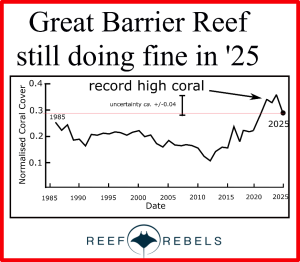
The latest 2025 statistics on the amount of coral on the Great Barrier Reef show the reef is still doing fine despite having six allegedly cataclysmic coral bleaching events in the last decade. There should be no coral at all if those reports were true.
The normalised coral cover dropped from a record high number of 0.36 down to 0.29, but there is still twice as much coral as in 2012. The raw coral cover number for all the last five years has been higher than any of the previous years since records began in 1985.
However, when one considers the uncertainty margin, the present figures are not significantly different from many of the previous years. The Australian Institute of Marine Science collects coral data on around 100 of the 3000 individual coral reefs of the GBR. Analysis of the data at smaller scales shows the GBR is doing what it always does – change. There is a constant dynamic as cyclones, starfish plagues and bleaching events dramatically kill lots of coral in small areas, while it quietly regrows elsewhere.
Great Barrier Reef sees record levels of coral despite climate fearmongering
Marine Physicist Peter Ridd slams the misinformation pushed on the Great Barrier Reef’s… more
Guess whether the “science” institutions emphasise the death or regrowth.
The institutions often justify this embarrassingly high coral cover as just “weed coral”. But the type of coral that has exploded over the past few years is acropora, which is the most susceptible to hot-water bleaching. How can we have record amounts of the type of coral that should have been killed, again and again, from bleaching? The acropora takes five to 10 years to regrow if it is killed.
There are two conclusions that must be drawn. First, not much coral has been killed by climate change bleaching – at least not compared to the capacity of coral to regrow. Second, the science institutions are not entirely trustworthy, and are in need of major reform.
And not just with regard to GBR or climate science. It is well recognised that most areas of scientific study are suffering a problem of reliability, which is damaging the reputation of science itself. It is well accepted that around half of the recent peer-reviewed science literature is flawed. Is there any other profession with such a high failure rate?
This commentary was originally published in The Australian (paywalled) on August 6, 2025.
Peter Ridd, Ph.D. is an Adjunct Fellow at the Institute of Public Affairs and a member of the CO2 Coalition.